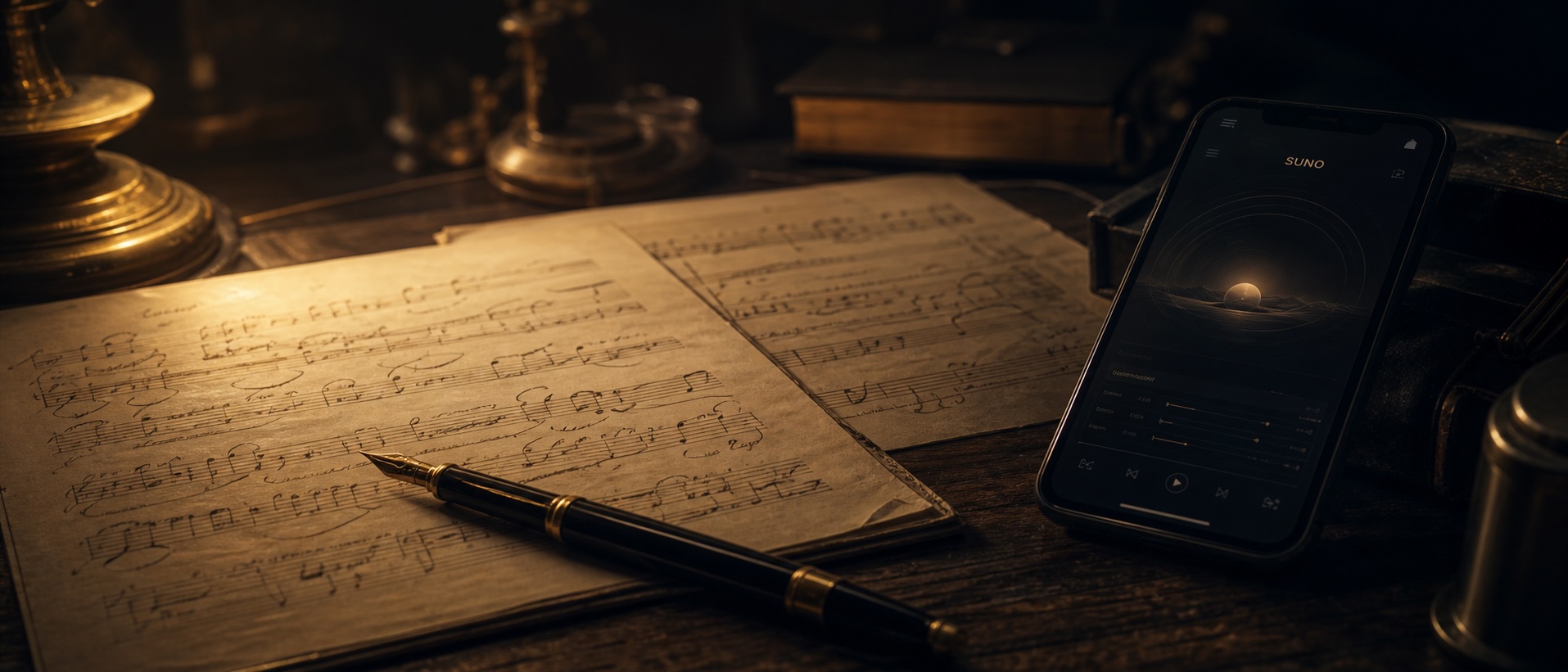
// Suno Film Music Guide

What would
Morricone prompt?

Now you know. So does Zimmer, Herrmann,
Greenwood, and 20 more.

Six decades of film scoring history, distilled into composer-specific Suno prompts. From John Williams' 1977 orchestral revolution to Ludwig Goransson's Afrofuturist hybrids. With a complete guide to structure tags, sliders, and the techniques that turn 30-second sketches into 3-minute cues.
Get the Guide
$29 One-time · Instant download
Suno Film Music Guide Cover
50+
Prompts
22
Composers
6
Decades
3
Sliders
Film scoring atmosphere

// Six Decades

Every era. Every sound.

1970s
Epic Orchestral
1980s
Synth Era
1990s
World & Intimacy
2000s
Hybrid Scores
2010s
Bass & Drone
NOW
Afrofuturism

John Williams · Ennio Morricone · Bernard Herrmann

The decade that defined scale

Star Wars and Jaws returned the full symphony orchestra to popular cinema. Morricone was rewriting genre rules in Italy. Herrmann's final years produced the sonic language of psychological dread. Giorgio Moroder's Midnight Express Oscar announced that synthesisers were legitimate scoring tools.

// Example prompt — John Williams

sweeping orchestral fanfare, full brass section,
heroic strings, John Williams style, 1977,
leitmotif, clear melody, no vocals, instrumental

// Example prompt — Morricone

spaghetti western, whistled melody, sparse guitar,
orchestral swell, Morricone style, desert atmosphere,
lyrical and stark, no vocals, instrumental

Vangelis · John Carpenter · Danny Elfman · Faltermeyer

The decade the synth took over

Blade Runner created neo-noir electronic as a category. Carpenter scored his own horror with single-finger ostinatos that still frighten. Elfman brought post-punk grotesque into the orchestra. MTV changed how directors thought about music on screen entirely.

// Example prompt — Vangelis / Blade Runner

neo-noir synthesiser atmosphere, slow chord pads,
emotional lead synth, Vangelis Blade Runner style,
1982, rain neon cityscape, no vocals, instrumental

// Example prompt — Carpenter

minimalist horror synthesiser, single note ostinato,
slow dark chords, John Carpenter Halloween style,
5/4 time, dread, no vocals, instrumental

Thomas Newman · Hans Zimmer · Angelo Badalamenti

The decade of texture and intimacy

Thomas Newman developed oblique harmonies that refuse to tell you how to feel. Zimmer pioneered the hybrid approach. Hip-hop arrived as a scoring language. Tarantino's use of existing tracks redefined music supervision as composition.

// Example prompt — Thomas Newman

sparse film score, prepared piano, unusual marimba,
pentatonic melody, Thomas Newman style,
melancholy suburban, no vocals, instrumental

// Example prompt — Badalamenti

dark jazz film score, slow brushed drums,
moody bass, tremolo guitar, Badalamenti Twin Peaks,
dreamy surreal, no vocals, instrumental

Howard Shore · Jonny Greenwood · Clint Mansell

The hybrid decade

Shore's Lord of the Rings deployed a complete leitmotif system across eleven hours. Greenwood brought Penderecki string clusters into PTA films. Mansell's Requiem became the most remixed film cue of the decade. Trailer music was born as its own industry.

// Example prompt — Howard Shore

epic orchestral score, Celtic folk theme,
full orchestra, choral voices, Howard Shore LOTR,
heroic fantasy, leitmotif, no vocals, instrumental

// Example prompt — Greenwood

avant-garde string ensemble, cluster chords,
Greenwood There Will Be Blood style,
psychological intensity, no vocals, instrumental

Reznor & Ross · Jóhannsson · Cliff Martinez · Gudnadottir

The decade of bass and restraint

The Inception BRAAAM became cultural shorthand. Reznor and Ross won Academy Awards, announcing the producer-composer era. Gudnadottir recorded the Joker score before filming. Jóhannsson created genuinely alien soundscapes for Arrival before his death at 48.

// Example prompt — Reznor & Ross

electronic ambient film score, cold industrial texture,
Reznor Ross Social Network style,
digital loneliness, no vocals, instrumental

// Example prompt — Cliff Martinez

retro electronic film score, kosmische arpeggio,
Cliff Martinez Drive style, neon night,
cool moody, no vocals, instrumental

Goransson · Nicholas Britell · Jonny Greenwood

The post-everything era

Goransson reinvents himself for every project. Britell writes themes that mean different things each time they appear. The line between score and sound design has dissolved. Afrofuturism and global music languages are structural principles now, not exotic colour.

// Example prompt — Goransson / Oppenheimer

intense orchestral score, Goransson Oppenheimer style,
rhythmic string writing, relentless pressure,
no melody, no vocals, instrumental

// Example prompt — Britell / Succession

baroque hip-hop chamber score, harpsichord,
Britell Succession style, aristocratic dark comedy,
no vocals, instrumental

// What's Inside

Everything a working composer needs.
Nothing you don't.

50
🎼
Composer-Specific Prompts
Two prompts per composer, built around their actual techniques. Not just "1970s orchestral" — Williams' transparent brass voicing, Herrmann's unresolved chromaticism, Morricone's voice-as-instrument approach.
🏷
Structure Tag System
The solution to 30-second generations. Use [quiet tension], [build], [dramatic climax], [aftermath silence] and more. 18 tags documented, 5 genre templates, and a length formula that gives you 3+ minutes every time.
🎛
The Three Sliders Explained
Weirdness, Style Influence, and Audio Influence. Exact settings for eight scoring situations, from period-accurate orchestral to full avant-garde chaos. A settings matrix you'll return to every session.
🎬
Scene-Type Quick Prompts
Chase sequences, love themes, end credits, trailer stings (8 sec), horror builds, villain themes, dream sequences. Ready to use, ready to adapt.
📖
Decade-by-Decade History
Not a Wikipedia summary. Each decade covers what actually changed: the pop influences, the avant-garde experiments, the orchestral traditions as they evolved — and why it matters for your prompts.
⚙️
Advanced Workflow
BPM targeting, double vocal suppression, seeding with your own audio at 65-75% influence, section editing over full regeneration, and stem export for DAW integration.

// 22 Composers Covered

Every voice has its own prompt.

John Williams
1970s – now
Star Wars, Jaws, Schindler's List
Ennio Morricone
1960s – 2016
The Mission, Once Upon a Time
Bernard Herrmann
1940s – 1975
Psycho, Taxi Driver
Lalo Schifrin
1960s – 1980s
Dirty Harry, Enter the Dragon
Giorgio Moroder
1970s – 1980s
Midnight Express, Top Gun
Vangelis
1980s – 2000s
Blade Runner, Chariots of Fire
John Carpenter
1970s – 1980s
Halloween, The Thing
Danny Elfman
1985 – now
Batman, Edward Scissorhands
Harold Faltermeyer
1980s
Beverly Hills Cop, Fletch
Thomas Newman
1990s – now
American Beauty, Shawshank
Hans Zimmer
1988 – now
Gladiator, Inception, Dune
Angelo Badalamenti
1986 – 2018
Twin Peaks, Lost Highway
Carter Burwell
1984 – now
Fargo, Being John Malkovich
Howard Shore
1978 – now
Lord of the Rings, Silence of the Lambs
Clint Mansell
1995 – now
Requiem for a Dream, Moon
Jonny Greenwood
2003 – now
There Will Be Blood, Spencer
Trent Reznor & Atticus Ross
2010 – now
Social Network, Gone Girl
Jóhann Jóhannsson
2005 – 2018
Arrival, Sicario
Cliff Martinez
1989 – now
Drive, Only God Forgives
Hildur Gudnadottir
2018 – now
Joker, Chernobyl
Ludwig Goransson
2013 – now
Black Panther, Oppenheimer
Nicholas Britell
2016 – now
Succession, Moonlight

// Sample Prompts

Built around technique,
not just taste.
John WilliamsHeroic Fanfare
sweeping orchestral fanfare, full brass section, heroic strings, John Williams style, 1977, leitmotif, clear melody, no vocals, instrumental
Hildur GudnadottirPsychological Breakdown
solo cello film score, dissonant harmonics, Gudnadottir Joker style, psychological breakdown, raw and abrasive, slow building dread, no vocals, instrumental
Cliff MartinezNeon Night
retro electronic film score, kosmische synthesiser arpeggio, Cliff Martinez Drive style, neon night, cool moody 2011, no vocals, instrumental
Jonny GreenwoodDissonant Strings
avant-garde string ensemble, cluster chords, Greenwood There Will Be Blood style, psychological intensity, oil and obsession, prepared piano, no vocals, instrumental
Ludwig GoranssonAfrofuturist Hybrid
Afrofuturist hybrid score, West African kora and drums, orchestral strings, hip-hop production, Goransson Black Panther style, no vocals, instrumental

// The Three Sliders

Control the variables.

Weirdness
SafeChaos
How far from convention
Low: predictable rhythms, simple melodies, genre-accurate output. High: unusual intervals, complex rhythm, processing artifacts.

Film sweet spot: 30–55% for most dramatic cues. Push to 65–75% for psychological or avant-garde scenes.
Style Influence
LooseStrong
How closely Suno follows your prompt
High: tight genre accuracy, sounds exactly like what you described. Low: your prompt is a starting point, Suno interprets freely.

Film sweet spot: 65–80% for period-accurate scores. Drop to 30–50% for hybrid genre experiments.
Audio Influence
GhostLead
How strongly your upload guides output
Only active when you upload a reference. High: output closely mirrors your reference timbre and feel. Low: reference used as a subtle texture hint.

Film sweet spot: 65–75% when seeding with your own melodic material.

// Structure Tags

Stop getting 30-second sketches.

[quiet tension]
Low volume, high unease. Horror, stalking.
[build]
Rising energy toward a climax.
[dramatic climax]
Maximum orchestral density. Reveals.
[breakdown]
Strip to minimal. Aftermath and grief.
[silence]
Actual pause. Jump scare setup.
[instrumental break]
Forces no vocals through this section.
[ethereal]
Floating, otherworldly. Sci-fi, dreams.
[fade out]
Gradual reduction to end. Credits.
Length by number of tags
3 tags
~90 sec
5 tags
~2.5 min
7 tags
~3.5 min
7+ + Extend
4 min+

The guide includes 5 complete genre templates — thriller, epic action, drama, horror, sci-fi — plus 18 tags documented with film-specific use cases.

Tip: Repeating a tag generates a full second iteration. Two [climax] entries = two full climaxes.

Lighthouse

// By

Lighthouse
Film Composer · Music Publisher · Oslo

A Norwegian film composer and music publisher whose work spans orchestral scoring, electronic textures, and the hybrid language that defines contemporary cinema sound. Currently scoring a feature film in the Nordic tradition. The Suno Film Music Guide emerged from years of working at the intersection of composition and technology — a working composer's attempt to map the history of film scoring in terms that actually help you make something.

2× Spellemann Award
Multi-Platinum
Film Composer
Music Publisher
Film scoring detail

Start scoring like you
know what you're doing.

Instant download. One PDF. Every prompt, slider setting, and structure tag you need.

$29
One-time payment · No subscription · Instant PDF download
Get the Guide Now

Delivered via Gumroad. PDF opens on any device.